How Does an X-Ray Machine Work? Industrial X-Ray Inspection Guide
This guide systematically explains the core principles of X-ray machines, system components, detection logic, equipment selection, safety standards, and industry applications. It covers non-destructive testing (NDT) in food, pharmaceutical, electronics, packaging, automotive parts, and security inspection scenarios, providing professional references for equipment procurement, operation, and compliance management.
Table of Contents
- X-Ray Machine Overview & Core Applications
- X-Ray Generation & Physical Properties
- Core Components of X-Ray Inspection Systems
- X-Ray Imaging & Detection Principles
- Intelligent X-Ray Detection Algorithms
- Industrial X-Ray Machine Design & Performance Metrics
- X-Ray Reject Systems & Actuators
- Performance Verification & Industry Compliance
- Safe Operation & Daily Maintenance
- Frequently Asked Questions (FAQ)
X-Ray Machine Overview & Core Applications
An X-ray machine (X-ray inspection system) is a precision testing device that uses X-ray penetration and differential absorption properties to visualize internal structures, detect foreign bodies, and identify defects. It is a core tool in modern industrial production, quality control, and security inspection.
Core Classification of X-Ray Machines
Industrial X-Ray Inspection Systems
Used for in-line foreign body detection, product defect identification, missing part detection, and density measurement in food, pharmaceutical, electronics, packaging, and automotive parts industries. Enables high-speed, high-precision non-destructive testing (NDT).
Medical Diagnostic X-Ray Machines
Used for clinical diagnosis in hospitals, including dental, orthopedic, and respiratory imaging. Visualizes lesions and structures through differential X-ray absorption by human tissues, characterized by static, short-term low-dose exposure.
Security X-Ray Scanners
Used for baggage and parcel inspection at airports, train stations, customs, and courier logistics. Identifies contraband and dangerous goods through X-ray imaging, characterized by large field of view, low-resolution imaging, and manual image interpretation.
Core Value of Industrial X-Ray Inspection
- Non-Destructive Testing (NDT): Inspects internal foreign bodies, defects, and structures without damaging products, leaving them intact for use.
- Full-Process Quality Control: Integrates into production lines for 100% in-line high-speed inspection, eliminating non-conforming products from reaching the market.
- Compliance Assurance: Meets global food safety system requirements such as HACCP, BRCGS, and IFS.
- Cost Reduction & Efficiency Improvement: Reduces manual inspection errors and costs, and minimizes customer complaints, recalls, and brand damage caused by foreign bodies.
X-Ray Generation & Physical Properties
Core Physical Properties of X-Rays
X-rays are extremely short-wavelength, high-energy electromagnetic waves with a wavelength range of 0.001 nm to 10 nm. They have the following core properties, which form the basis of their detection capabilities:
- Penetration: Can penetrate objects opaque to visible light. Penetration power is directly related to X-ray energy, and the density and thickness of the object being penetrated.
- Differential Absorption: Substances with different densities and atomic numbers absorb X-rays differently. Higher density and atomic number result in stronger absorption.
- Ionization Effect: Can ionize substances, which is the core basis for radiation safety management.
- Photographic Effect: Can expose film and be captured by detectors and converted into electrical signals, ultimately forming visual images.
X-Ray Generation Process
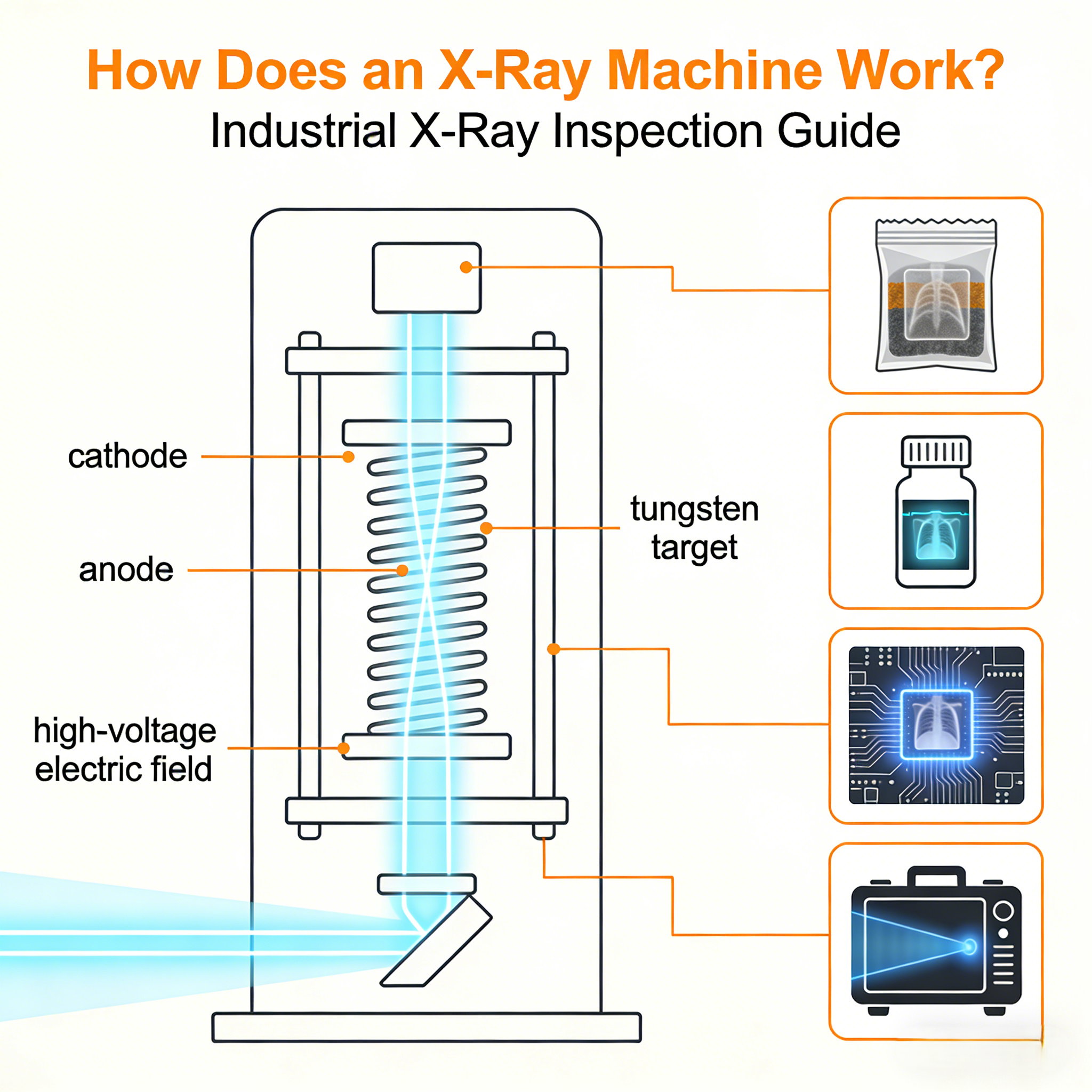
The core of X-ray generation is the collision of high-speed moving electrons with a metal target. The complete process consists of 3 core steps:
- Electron Emission: Alternating current (typically 220VAC) is applied to the cathode filament, which heats up and releases a large number of free electrons that accumulate in the cathode area.
- Electron Acceleration: A high-voltage electric field is applied between the cathode and anode, and free electrons move toward the anode at extremely high speeds under the action of the high voltage, forming a high-speed electron beam.
- X-Ray Emission: The high-speed electron beam collides with the tungsten target (a high atomic number, high melting point metal) on the anode. The kinetic energy of the electrons is rapidly converted, with approximately 1% converted into X-rays and the remaining 99% into heat. Therefore, the equipment must be equipped with a dedicated cooling system.
Core Components of X-Ray Inspection Systems
A complete industrial X-ray inspection system consists of three core hardware units + supporting software systems, which work together to complete the full process of X-ray emission, signal acquisition, image processing, foreign body identification, and execution control.
X-Ray Generator
The core emission unit of the equipment, responsible for generating stable X-rays. Its core performance parameters determine the equipment's penetration power and upper detection limit.
- Common power specifications: 20W, 100W, 420W, adapted to different product thicknesses and densities.
- Core parameters: kV (tube voltage) determines X-ray penetration power; higher kV means stronger penetration. mA (tube current) determines image contrast; higher mA means clearer images and better detail.
- Intelligent optimization technology: Automatically matches optimal kV/mA parameters based on product type and inspection speed, eliminating manual adjustment and balancing inspection accuracy and energy consumption.
X-Ray Detector
The signal acquisition unit of the equipment, responsible for capturing residual X-ray energy after penetrating the product and converting it into electrical signals for system processing. It directly determines imaging accuracy and lower detection limit.
- Common specifications: 0.4mm detector, adapted to micro-contaminant detection, can identify smaller foreign bodies; 0.8mm detector, adapted to high-dose, high-line-speed production line scenarios.
- New-generation TDI technology: Multi-line array scanning technology, which scans products with multiple line array sensors for signal superposition, achieving more than 5x signal enhancement, clearer imaging, higher foreign body detection rates, and lower X-ray intensity requirements and energy consumption.
Control System & Image Processing Unit
The "brain" of the equipment, responsible for image calculation, algorithm identification, logic control, and data management. It consists of an industrial computer, motion control module, and human-machine interface (HMI).
- Image processing: Converts electrical signals collected by the detector into grayscale images, and completes preprocessing such as image correction, enhancement, and filtering.
- Algorithm identification: Identifies foreign bodies and defects in images through detection algorithms, and outputs inspection results and reject signals.
- Logic control: Controls the coordinated operation of the conveyor system and reject mechanism to complete in-line product inspection and non-conforming product rejection.
- Data management: Stores inspection data, product parameters, and alarm records, and supports production traceability and report export.
Supporting Auxiliary Systems
- Conveyor system: Enables uniform in-line product transmission, typically a belt conveyor, adapted to production line speed requirements.
- Protection system: Lead-shielded body, protective curtains, and other structures to block X-ray leakage and ensure equipment radiation meets national safety standards.
- Reject actuator: Receives inspection signals from the system and accurately rejects non-conforming products from the production line.
- Cooling system: Provides cooling protection for the X-ray generator to ensure long-term stable operation of the equipment.
X-Ray Imaging & Detection Principles
X-Ray Grayscale Imaging Principle
The core of X-ray imaging is based on the differential absorption of X-rays by substances, which is converted into a visual grayscale image. The complete imaging logic is as follows:
- X-rays penetrate the product being inspected, some are absorbed by the product, and the residual X-ray energy reaches the detector.
- The detector converts X-ray signals of different intensities into corresponding electrical signals, which are finally mapped to grayscale pixel values ranging from 0 (pure black) to 255 (pure white).
- Substances with higher density absorb more X-rays, leaving less energy to reach the detector, resulting in lower pixel values and darker areas in the image. Substances with lower density absorb less, resulting in brighter areas.
- The system compares the grayscale difference between the normal product template and the inspected product, and identifies abnormal areas (foreign bodies/defects) through algorithms.
Core Foreign Body Detection Logic: Density Difference Principle
The foreign body detection capability of X-rays depends on the density difference between the foreign body and the product being inspected, following the Beer-Lambert Law: When X-rays pass through a substance, their intensity decays exponentially with the thickness and density of the substance.
Core formula: I = I₀ × e^(-μρd), where I is the residual X-ray intensity, I₀ is the initial X-ray intensity, μ is the mass absorption coefficient of the substance, ρ is the density of the substance, and d is the thickness of the substance.
Core Conclusion: The greater the density difference between the foreign body and the product, the more obvious the X-ray absorption difference, and the easier it is to detect and identify. Conversely, the closer the density, the higher the detection difficulty.
Quick Judgment Rule: If a foreign body floats on water (density < 1 g/cm³), it is difficult to achieve stable detection with conventional X-ray equipment.
Common Foreign Body Detection Capability Comparison Table
| Common Foreign Body Type | Density (g/cm³) | Typical Minimum Detectable Size | Detection Difficulty |
|---|---|---|---|
| Wood, string, insects, fruit pits, plant stems | 0.7 | Generally cannot be stably detected | Extremely High |
| Low-density plastic | 0.9-1.2 | >4mm | High |
| Water (reference substance) | 1.0 | - | - |
| High-density rubber, bone, clumps, ceramic | 2.5 | >2mm | Medium |
| Aluminum | 2.7 | >2mm | Medium |
| Stone, high-density plastic | 3.0 | ≥0.8mm | Low |
| High-density glass | 6.0 | ≥0.5mm | Very Low |
| Non-ferrous metals (copper, zinc, etc.) | 7.5 | ≥0.5mm | Very Low |
| Iron, stainless steel | 7.5-8.0 | ≥0.3mm | Extremely Low |
Core Factors Affecting Inspection Accuracy
1. Product Thickness and Density
The greater the product thickness and density, the significantly lower the inspection sensitivity. For example:
- In a 10mm thick food product, a 1.0mm stainless steel foreign body brings a 70% increase in X-ray absorption, which is easily identifiable.
- In a 100mm thick food product of the same type, a 1.0mm stainless steel foreign body brings only a 7% increase in X-ray absorption, which is much more difficult to identify.
2. Equipment Hardware Performance
The upper limit of the generator's kV/mA and the resolution of the detector directly determine the equipment's imaging quality and minimum detectable size. High-resolution detectors and high-power generators can achieve higher inspection accuracy.
3. Density Difference Between Foreign Body and Product
The greater the density difference, the lower the detection difficulty; the closer the density, the higher the requirements for the equipment's algorithms and hardware.
4. Production Line Speed
The faster the line speed, the shorter the detector's exposure time, the less signal collected, and the lower the imaging quality. Higher-spec hardware and algorithm optimization are required.
Intelligent X-Ray Detection Algorithms
The algorithm system is the core determinant of an X-ray machine's inspection accuracy, false reject rate, and ease of use. The new-generation intelligent detection algorithm can achieve fully automatic parameter setting, high-precision foreign body identification, and low false reject rate operation, greatly reducing the equipment's operation threshold and usage cost.
Core Algorithm Functions
Fully Automatic Product Setup
- One-click completion of product template learning, automatically matching optimal inspection parameters, image thresholds, and algorithm models.
- Eliminates the need for operators to have professional X-ray knowledge, greatly reducing training costs and quickly completing product changeovers.
- Supports English product name input and product image import, making product management more intuitive and convenient.
Intelligent Foreign Body Identification Algorithms
- Multi-algorithm fusion adaptation, matching the optimal detection algorithm for different products and foreign body types, balancing detection rate and false reject rate.
- Can identify various foreign bodies such as metal, glass, stone, bone, and plastic, and simultaneously complete defect detection such as missing parts, breakage, underfilling, and clumping.
- New-generation image processing technology that effectively suppresses image interference caused by product wrinkles, packaging materials, and uneven product density, greatly reducing the false reject rate.
Additional Value of Algorithm Systems
- Data Traceability and Management: Automatically stores every inspection image, alarm data, and reject record, supports query and export by batch, time, and product type, and meets production traceability and compliance audit requirements.
- Multi-Level Permission Management: Supports operator, administrator, and engineer multi-level permission assignment to prevent accidental parameter modification and ensure stable equipment operation.
- Intelligent Reminders and Diagnostics: Equipment failure warnings, performance verification cycle reminders, and operation step guidance reduce equipment maintenance difficulty.
- Industry 4.0 Compatibility: Supports B/S architecture and Ethernet communication, and can be connected to factory MES and ERP systems to achieve interconnection of production data.
Algorithm Performance Test Results: Compared with traditional detection algorithms, the new-generation intelligent algorithm can increase the foreign body detection rate by 5%-20%, reduce the false reject rate by 30%-60%, and shorten product changeover time by more than 80% in food, pharmaceutical, and other scenarios.
Industrial X-Ray Machine Design & Performance Metrics
The design of a high-quality industrial X-ray machine must balance four core dimensions: inspection performance, ease of operation, ease of maintenance, and safety compliance. The core design points are as follows:
Human-Machine Interaction (HMI) Design
- HD touchscreen: Typically 15.6-inch or larger capacitive touchscreen with anti-glare design, full-angle viewing, and smooth and sensitive operation.
- What-You-See-Is-What-You-Get (WYSIWYG) interface: Menu-based navigation guidance, real-time image changes during parameter adjustment, and quick start without professional training.
- User-friendly operation design: Error reminders to prevent misoperation, performance verification operation guidance, and one-click product recipe switching to adapt to rapid production line changeover requirements.
Hygiene and Protection Design
- Protection Rating: Standard IP65 protection rating for the whole machine, can be upgraded to IP66 for wet production environments, supporting whole-machine washdown.
- Hygiene Design: Sloped body, round tube bracket design, no hygiene dead corners, avoiding water and dust accumulation; polished welds to reduce dust and bacterial adsorption, adapting to hygiene requirements of food and pharmaceutical industries.
- Quick-Release Structure: Quick-release belt and protective curtain design, can be quickly disassembled, cleaned, and replaced without tools, greatly shortening cleaning and maintenance time.
- Food-Grade Materials: Belts and protective curtains in contact with products are made of FDA-compliant food contact materials to avoid secondary product contamination.
Safety Design
- Radiation Safety: Whole-machine lead-shielded design, radiation leakage strictly controlled within the national safety limit of <1 μSv/h, far lower than the public radiation dose limit.
- Electrical and Mechanical Safety: Designed in compliance with CE safety standards, including emergency stop buttons, independent start/stop switches, safety door locks, and safety circuit design to avoid equipment operation risks.
- Anti-Deviation Design: Dual-shaft conveyor structure to avoid belt deviation and ensure stable production line operation; raised table design to avoid belt adhesion in wet environments.
Core Performance Metrics
- Inspection width: Typically 100mm-600mm, customizable large-field-of-view specifications to adapt to different product sizes.
- Inspection height: Typically 50mm-300mm, matching product thickness and penetration requirements.
- Line speed adaptation: Typically 10m/min-60m/min, customizable high-speed specifications to adapt to high-capacity production lines.
- Inspection accuracy: Stainless steel ≥0.3mm, glass ≥0.5mm, stone/bone ≥2mm, depending on product characteristics and equipment specifications.
- Power supply specification: Typically single-phase 220V 50/60Hz, adapting to factory power supply environments.
X-Ray Reject Systems & Actuators
The reject system is the core execution unit of in-line X-ray inspection, responsible for receiving inspection signals from the system and accurately rejecting non-conforming products containing foreign bodies/defects from the production line to prevent them from entering the next process. There are 4 main types of reject methods, adapted to different product types and production line scenarios.
Air-Blast Rejector
Adapted Scenarios: Small packages and sachets weighing ≤500g, mainly for high-speed production line small package inspection scenarios.
Working Principle: Controls high-pressure air flow through a high-frequency solenoid valve to blow non-conforming products off the conveyor line. Fast response, simple structure, and adapted to high-speed lines.
Pusher Rejector
Adapted Scenarios: Medium-weight, heavy-weight boxed, bottled, and canned products, as well as rigid packaging products.
Working Principle: Drives a pusher through a side-mounted cylinder to push non-conforming products out of the side of the conveyor line at high speed. Strong rejection force, high stability, and adapted to heavy products.
Retractable Belt Rejector
Adapted Scenarios: Heavy-weight, large-volume full-case products, barreled products, and fragile products.
Working Principle: The roller table at the end of the conveyor line can quickly retract to form a drop gap in the product flow, and non-conforming products fall into the collection box by gravity. The table quickly resets after rejection, with low impact on products to avoid breakage.
Drop-Through Rejector
Adapted Scenarios: Light-weight small and medium-sized sachets and boxed products, and the mainstream standard configuration for small and medium-sized X-ray machines.
Working Principle: After detecting a non-conforming product, the cylinder drives the conveyor plate chain to quickly drop down to form a drop channel, and the non-conforming product falls into the rejection collection area by gravity. The plate chain quickly resets after the signal disappears, without affecting the transmission of normal products. Accurate rejection and low false reject rate.
Core Points for Reject System Selection
- Match the product's packaging type, weight, and size. For fragile products, prioritize reject methods with low impact on products.
- Adapt to the production line speed. For high-speed lines, prioritize air-blast and pusher rejectors with fast response.
- Equipped with rejection confirmation and no-material detection functions to avoid missed rejection and false rejection, ensuring 100% rejection accuracy.
- The reject mechanism complies with food hygiene design requirements, has no hygiene dead corners, and is easy to clean and maintain.
Performance Verification & Industry Compliance
Performance verification of X-ray machines is a core link to ensure long-term stable operation of equipment and meet industry compliance requirements. At the same time, it must comply with global mainstream food safety and radiation safety standards.
Equipment Performance Verification Specifications
1. Verification Test Sample Requirements
Calibrated standard test samples must be used, covering common foreign body types such as stainless steel, glass, stone, and plastic, with sizes covering the equipment's nominal lower detection limit. The samples must comply with food contact related standards to avoid product contamination.
2. Commissioning and Acceptance Test Methods
- False Reject Rate Test: Pass qualified normal products through the equipment 20 times continuously. No false alarms and no rejections are considered qualified.
- Detection Rate Test: Place standard test samples in different positions of the product (front, middle, end, edge, center), and pass them through the equipment 20 times continuously. 100% detection and rejection are considered qualified.
- Limit Test: Complete multiple rounds of continuous testing for the equipment's nominal minimum detection size to verify detection stability.
3. Daily Performance Verification Frequency
- During production operation: Typically perform performance verification every 2 hours, and the verification interval can be adjusted according to production requirements.
- When production batches are changed and product recipes are switched.
- After equipment inspection parameters are modified.
- After equipment maintenance and shutdown restart.
- Before daily production starts and after production ends.
Core Industry Compliance Standards
Food Safety Control Standards
As a key quality control equipment in the food and pharmaceutical industries, industrial X-ray machines must meet the following global mainstream food safety system requirements:
- HACCP (Hazard Analysis and Critical Control Points) System
- BRCGS (British Retail Consortium Global Standards) Food Safety
- IFS (International Featured Standards) Food
- SQF (Safe Quality Food) Code
- FSSC 22000 Food Safety System Certification
Radiation Safety Standards
- US/EU/Global Standard: IEC 61010-1, IEC 60335-2-107, FDA 21 CFR 1020.40, public surrounding radiation dose limit <1 μSv/h
- Local standards should be followed based on your region
Equipment Safety Standards
- CE Certification: Includes Mechanical Safety (MD), Electrical Safety (LVD), and Electromagnetic Compatibility (EMC) related standards
- Food Contact Materials Standards: FDA 21 CFR related food contact material regulations, EU 1935/2004/EC, etc.
Safe Operation & Daily Maintenance
Core Radiation Safety Operation Specifications
Core Safety Principle: The radiation leakage of compliant industrial X-ray machines is far lower than national safety limits, and normal operation will not cause harm to the human body. However, strict safety operation specifications must still be followed to avoid illegal operations.
- Operators must undergo professional training and be familiar with the equipment's safety operation procedures and radiation safety knowledge.
- When the equipment is running, it is strictly forbidden to remove the lead protective curtain, open the protective door, or allow any part of the body to enter the X-ray irradiation area.
- If the equipment has a damaged protective structure or a radiation alarm, it must be shut down and powered off immediately, and professional personnel must be contacted for maintenance. It is strictly forbidden to disassemble the machine without permission.
- Regularly conduct equipment radiation dose testing to ensure that radiation leakage meets national standards.
- It is strictly forbidden to irradiate the human body with X-rays or use the equipment for non-industrial inspection purposes.
Daily Maintenance and Care Specifications
Daily Maintenance Items
- Clean the equipment body, conveyor belt, and protective curtain to remove product debris and stains to avoid affecting inspection accuracy.
- Check whether the protective curtain is intact, with no damage or missing parts, to ensure the protective effect.
- Check whether the conveyor belt is deviated, damaged, or running smoothly.
- Complete equipment performance verification to confirm that inspection accuracy and rejection functions are normal.
- Check whether the emergency stop button and safety switches are normal and effective.
Weekly Maintenance Items
- Deep clean the equipment's internal hygiene dead corners and remove foreign body debris.
- Check whether the detector window and X-ray emission window have stains or dust, and clean them with a special dust-free cloth.
- Check whether the reject mechanism is running smoothly, and whether the cylinder and solenoid valve have air leakage or jamming.
- Check whether the equipment's electrical wiring is firm, with no looseness or damage.
Monthly/Quarterly Maintenance Items
- Lubricate and maintain the bearings and rollers of the conveyor mechanism.
- Check whether the equipment's cooling system is normal, and clean the dust from the cooling fan and heat sink.
- Back up the equipment's product parameters and inspection data to avoid data loss.
- Perform a comprehensive performance calibration of the equipment to ensure that inspection accuracy meets requirements.
- Check whether the equipment is well grounded to ensure electrical safety.
Frequently Asked Questions (FAQ)
Foreign objects that can be stably detected by X-ray machines include: metals such as stainless steel, iron, and copper, glass, stone, ceramic, bone, high-density plastic, rubber, and product clumps;
Foreign objects that are difficult to stably detect include: wood, paper scraps, insects, fruit pits, low-density plastic, etc. with a density lower than 1 g/cm³. Such foreign objects have an extremely small density difference with the product, and it is difficult to achieve stable identification with conventional equipment.
There are 4 core influencing factors: 1. The thickness and density of the product being inspected; the greater the thickness and density, the lower the inspection sensitivity. 2. The density difference between the foreign body and the product; the smaller the density difference, the higher the detection difficulty. 3. Equipment hardware performance, including generator power and detector resolution. 4. Production line speed; the faster the line speed, the lower the inspection accuracy will be.
For compliant industrial X-ray machines, radiation leakage is strictly controlled within the national safety limit of <1 μSv/h, which is equivalent to the radiation dose received from a 1-hour flight. Normal operation will not cause any harm to the human body.
When the equipment is running normally, the radiation dose 1 meter away from the machine body is close to natural background radiation, and no additional safety distance is required. Just avoid opening the protective structure or putting your body inside the equipment while it is running.
The core difference is the detection range: Metal detectors can only detect metal foreign bodies, and are easily affected by product packaging, salt content, and moisture content; X-ray machines can detect various foreign bodies such as metal, glass, stone, bone, and high-density plastic, have stronger anti-interference capabilities, and can also complete defect detection such as missing parts, breakage, and underfilling.
Selection suggestions: If you only need to detect metal foreign bodies, and the product is non-high-salt/high-moisture and non-aluminum foil packaging, you can choose a metal detector; if you need to detect a variety of non-metal foreign bodies, or the product is aluminum foil packaging, high-salt/high-moisture, and has high quality control requirements, you should choose an X-ray machine.
Common causes include: Non-standard product template learning, unreasonable inspection parameter settings, product wrinkles/uneven density, normal structural interference in the product, dirty detector or X-ray window, and aging equipment hardware.
Solutions: Re-complete product template learning and optimize inspection parameters and algorithm models; clean the equipment's detector, X-ray window, and conveyor belt; set a shielding detection area for the normal structure of the product; upgrade the intelligent detection algorithm to reduce false rejects caused by product interference.
